Caring for North Dakota
UND is advancing rural care through the ND85 initiative and a new partnership in health education.
You can.
Those two words may be the most important message a student can hear, said Marjorie Jenkins, Dean of the UND School of Medicine & Health Sciences (SMHS) and Vice President for Health Affairs. She believes that encouragement will help recruit more health professionals to North Dakota.
The state currently faces a shortage of more than 200 physicians, according to the SMHS’s 2025 Report on Health Issues for the State of North Dakota. One strategy for closing that gap is the ND85 initiative. Launched in 2025, the program aims to have 85% of students in UND’s medical doctor (M.D.) and physician assistant (P.A.) classes come from North Dakota by 2030 — a goal supported by research showing that providers are most likely to practice near their hometowns. Language in the North Dakota Legislature’s most recent higher education funding bill (SB2003) reinforces that goal.
“The real heart of the ND85 program is the fact that students out there are going to hear, ‘You can be a doctor. You can be a physician assistant. We’ll help you; we’ll guide you to get there. Once you’re here, we’re going to wrap around you and help you get to graduation,’” Jenkins said. “I’m so proud that North Dakotans will now hear ‘you can.’”
To spread that message, Jenkins and her team have taken a grassroots approach to raising awareness of healthcare careers, with the goal of reaching every high school in North Dakota. The medical school has also benefited from UND’s record enrollment, which has expanded the pool of local students interested in health careers.
Jenkins emphasized that ND85 is an expectation rather than a mandate — a shared commitment across the school rather than a requirement placed on applicants. The initiative has already created a ripple effect, prompting the SMHS to examine its learning environment and student support systems to ensure all students have the resources they need to succeed.
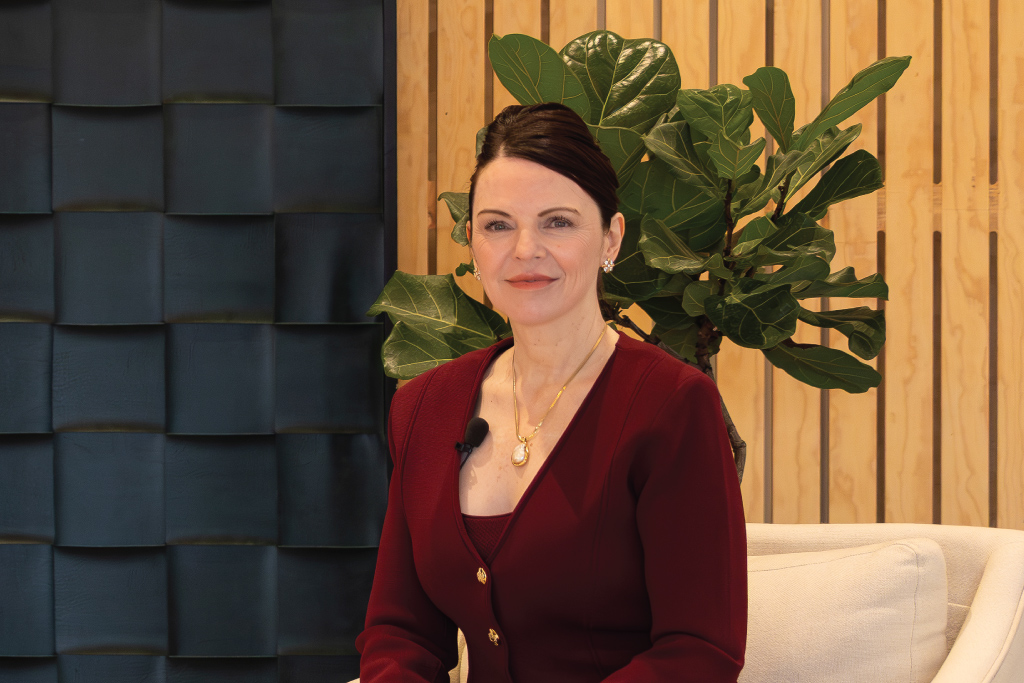
As one of eight children raised by a widowed mother in Appalachia, Marjorie Jenkins often heard the words, “You can’t.” Now, after serving as a professor of internal medicine and dean of the University of South Carolina School of Medicine Greenville, she leads UND’s medical school with a different message for students: “You can.”
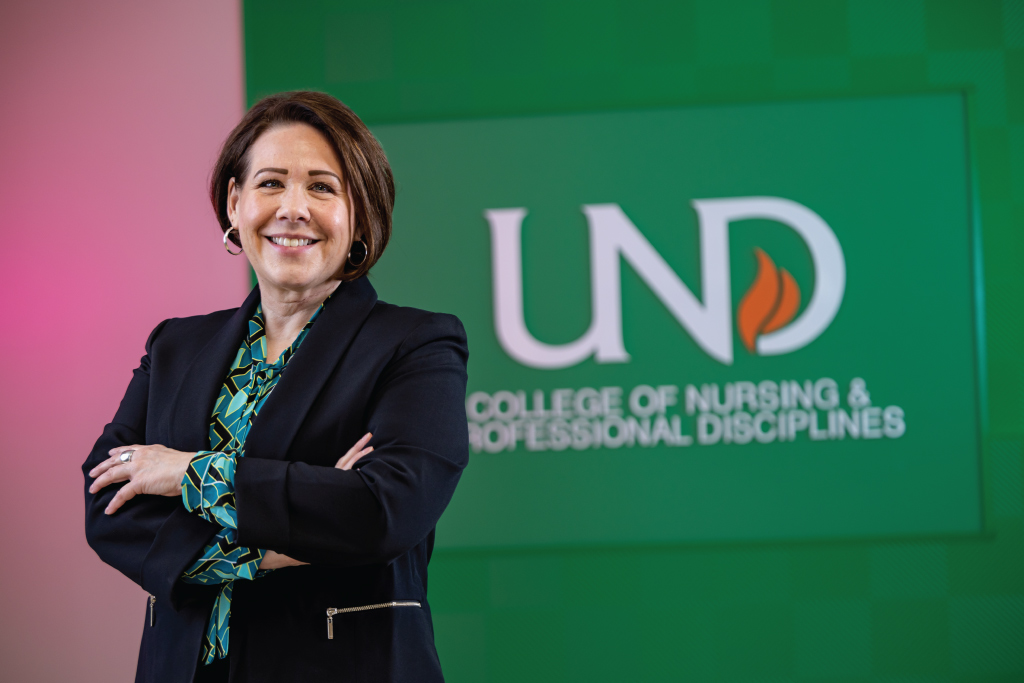
CNPD Dean Maridee Shogren, ’91, recalled a much tougher job market for new nurses. “When I graduated, there was hardly a job to be found,” she said. Shogren credits her UND co-op experience for her first position — a cardiac ICU role in Minneapolis. “I 100% believe I would not have gotten that job had I not been a graduate of this University.”
A Faster Path to Practice
The SMHS is making initial plans to launch the Primary Care Accelerated Track (PCAT) in 2028. The goal is for students in the program — initially focused on family medicine and internal medicine — to complete medical school in three years instead of four. Students would then enter a primary care residency in North Dakota and commit to practicing in the state for at least five years.
Jenkins said students who succeed in accelerated tracks often have health-related experience. “Many are second-career students who already know where they’re headed,” she said. “Others come from rural communities and want to return to serve those areas. They typically have a strong foundation in science and math and have already succeeded in rigorous coursework.”
After refining the initial program, SMHS plans to scale the PCAT model to other high-need fields, such as pediatrics and psychiatry.
Together with ND85, the PCAT program would be part of a broader effort to strengthen North Dakota’s healthcare workforce through earlier support, faster pathways, and more collaborative training.
A Collaborative Culture
Beyond curriculum, student success is shaped by the environment in which they train. The proposed Health Professions Collaborative Facility is a 95,000-square-foot addition to the SMHS building that would house College of Nursing & Professional Disciplines (CNPD) programs as well as biomedical research facilities. The project also includes much-needed clinic and research spaces.
“This is an opportunity to co-locate our programs,” said Maridee Shogren, CNPD Dean. “The proximity will allow our students to build professional relationships before they are out practicing.”
Jenkins emphasized that a building alone won’t change culture. “It is going to be great to be connected but I think it’s more the mindset of the conversations we are having — determining how we come together as multiple health profession disciplines to create that learning environment and then disseminate it across the state.”
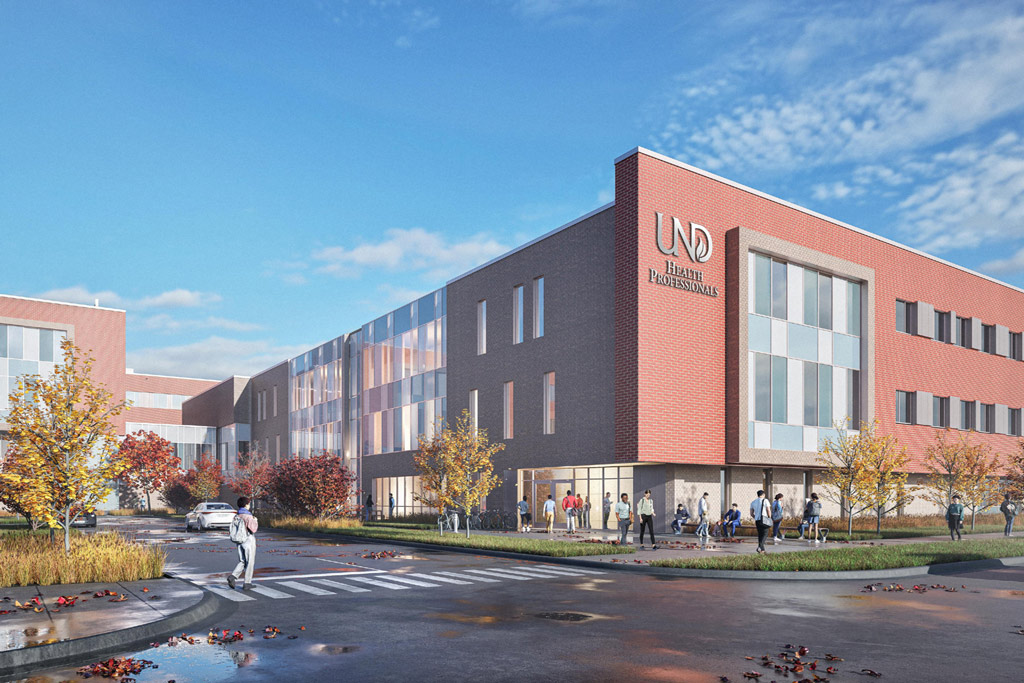
2025 architect rendering of future Health Professions Collaborative Facility
A Simulated Hospital
The proposed facility will house North Dakota’s first fully simulated hospital environment, where students across disciplines — including nursing, nutrition, and social work alongside medicine, P.A., and occupational and physical therapy — will work side by side.
“We can simulate the entire continuum of care,” Shogren said. “Whether it’s an emergency room admission or discharge planning to a long-term care facility, we can replicate it all. Since our state’s critical access hospitals often house clinics, ERs, and acute care inpatient beds under one roof, our students will train in that environment.”
The Digital Frontier
Jenkins sees this collaborative space and digital medicine as a “game-changer,” noting that students will be trained to use telehealth and AI as “force multipliers” to help rural clinicians manage specialized care locally.
The ultimate goals remain practical. “We are looking at improved health outcomes for North Dakotans,” Shogren said. “We want to graduate practice-ready professionals who have been immersed in interprofessional work.”
Both deans appreciate the forward-thinking approach of the initiative. “Being at the cusp of this transformation is something people might not expect when they think of North Dakota,” Jenkins said. “But they don’t know us.”
For UND, that transformation begins with telling every future provider, “You can.”
I think the game-changer is going to be how we do more with digital health and technology, how we do it better, and how we teach the next generation to use it.Marjorie Jenkins