Beneath the Surface
From a childhood far from the ocean to a career spent beneath it, Pete Witucki’s path into diving medicine is anything but ordinary.
Pete Witucki grew up about as far from the ocean as you can get. He didn’t know any divers in Grafton, North Dakota, and there certainly wasn’t a scuba tank in anyone’s garage. He was just a kid watching “Sea Hunt” on TV — his only exposure to a world he’d never seen.
Today, the UND alum is a Navy‑trained diving physician whose work often starts when a diver is in trouble. His path through emergency medicine and hyperbaric training has put him in the middle of cases where patients arrive confused, weak or unable to speak — symptoms of decompression sickness, also known as “the bends.”
“They come in with some pretty significant neurologic symptoms,” he said. “Sometimes we treat them one time, and they come out, and they’re fixed.”
That path began at UND, where Pete, ’90, joined the Navy Reserve while majoring in biology. “Education is a two-way street,” he said. “I was motivated to learn, and I was in a positive learning environment.”
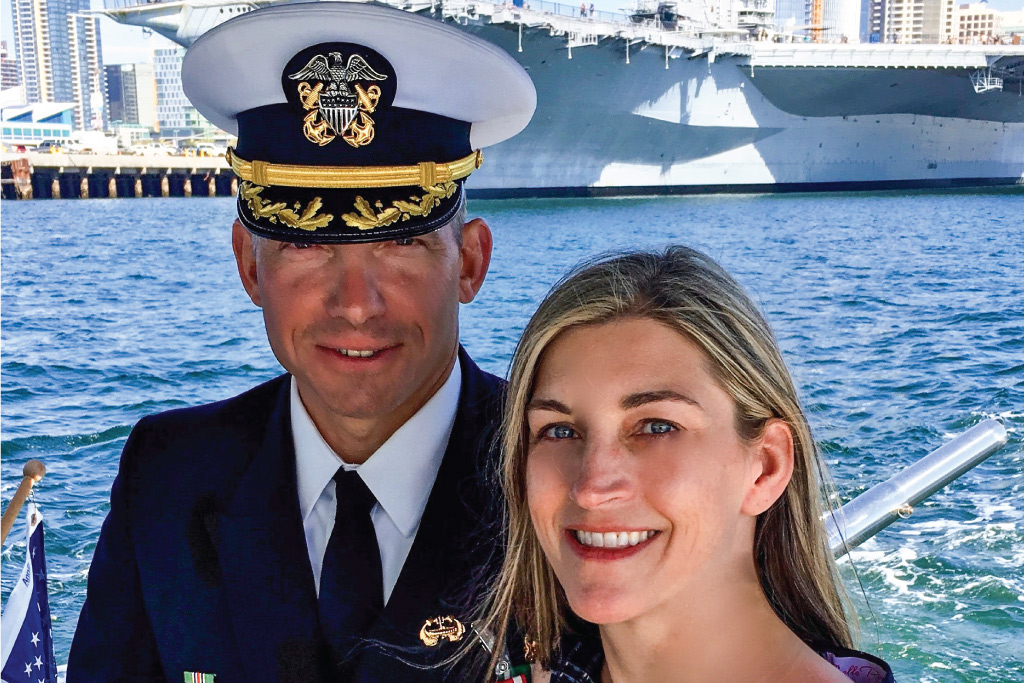
Pete is married to Angela (Stavig), '91, an occupational therapist.
A Different Kind of Medicine
After medical school at Loyola University Chicago, his active‑duty assignments took him to Connecticut and Florida, where he learned to operate hyperbaric chambers and became a diver.
“I thought, ‘I might as well get in the water,’” he said.
From there, his career moved deeper into the Navy’s underwater world. He served on an Explosive Ordnance Disposal dive team near Seattle and later returned to San Diego to run the medical clinic at Basic Underwater Demolition/SEAL training (BUD/S), the elite program that prepares future SEALs.
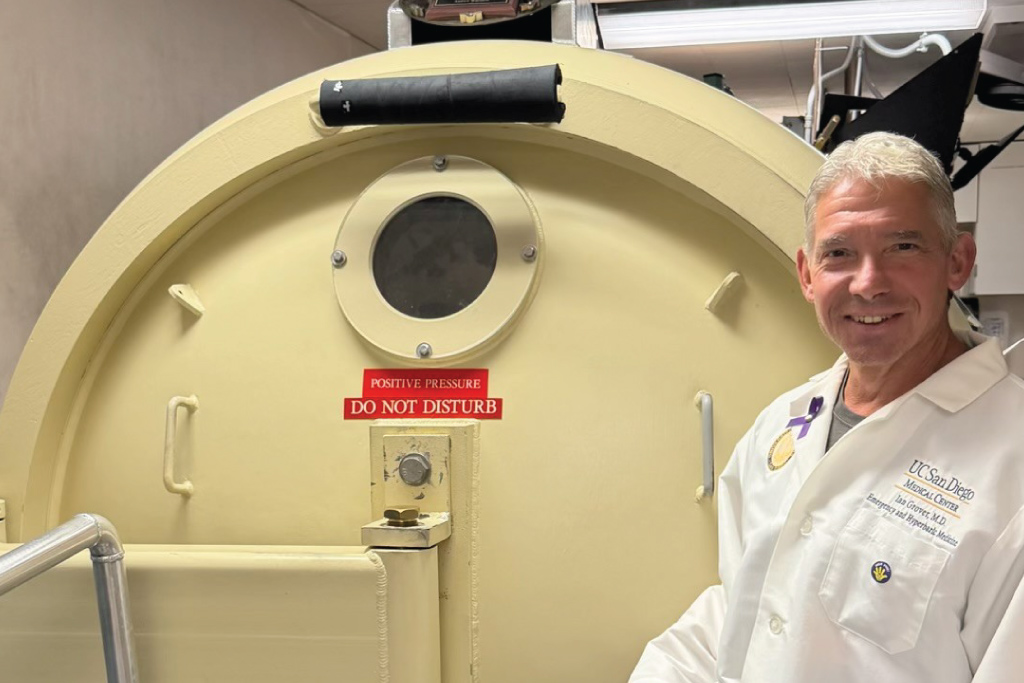
Pete works in hyperbaric medicine, which — in the Navy — treats diving-related emergencies like decompression sickness (“the bends”). Civilian medicine uses the same pressurized technology to treat chronic wounds, radiation injuries, and carbon monoxide poisoning.
Passing It Along
Pete retired from the U.S. Navy Reserve in 2017 after serving as an Undersea Medical Officer at two additional commands: SEAL Team-17 and Undersea Rescue Command.
Today, he mentors medical students, trains paramedics, and introduces younger physicians to hyperbaric medicine. He enjoys watching others experience the excitement he felt early in his own career.
“It’s fun to teach somebody something that they don't know how to do,” Pete said. “Working with somebody who’s seeing it for the first time reminds you that this stuff is kind of cool.”
You point young people from our state in the right direction, they’ll work hard and go places.Pete Witucki, ’90