A Lifelong Mission
How decades of Air Force and space operations experience prepared a UND alum to champion the Space Force.
As a child growing up in the 1970s, retired Brig. Gen. Damon Feltman, ’00, remembers lying on his back, putting his feet on a chair and pretending to pilot a space capsule. “I was a child of the Space Age,” he said.
That fascination turned into a career. Today, Damon serves as CEO of the Space Force Association. Drawing on more than three decades of military and aerospace leadership, he supports the members of the Space Force, grows the organization that serves them, and helps Americans better understand the nation’s newest military branch. SFA offers memberships to students and individuals at ussfa.org.
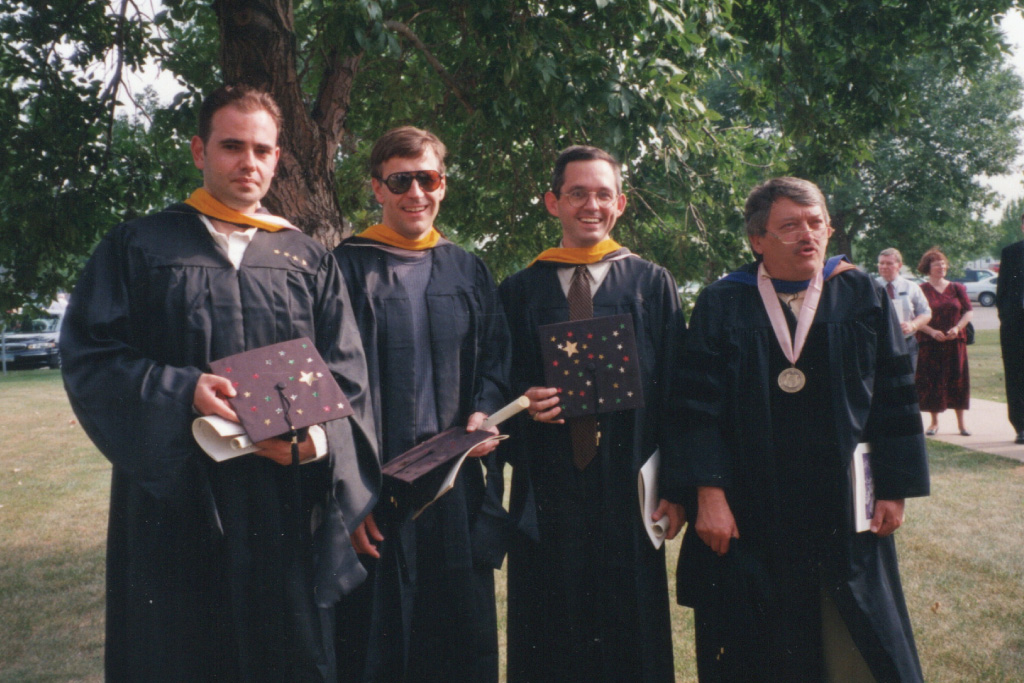
Damon Feltman (second from right) with Dr. Charles “Chuck” Wood (right) at UND graduation, August 2000.
Launching a Career
After graduating from Mississippi State University, Damon entered the Air Force as
a space operations officer in 1992. Three “atypical” assignments broadened his perspective
early on.
He worked on planetary defense and small-satellite concepts, now known as proliferated Low Earth Orbit (LEO) constellations. They are used for communications and missile tracking.
During that assignment, he was invited to watch a Delta Clipper reusable rocket demonstration. “It was a full 20 years before Elon Musk did reusable rockets,” he said. “Seeing a rocket flip over and land — that had never been done before, and it was amazing.”
He later joined the Air Force Reserve Command, where he oversaw fighter aircraft, bombers, remotely piloted aircraft, and cyber operations — a departure from his space background. “When I went to the Pentagon, I could talk very conversantly with the other side of the Air Force,” he said. “That helped break down barriers.”
From there, he moved to the Office of the Secretary of Defense, managing medical and
civil engineering programs supporting units from Alaska to Hawaii.
“Those experiences just put me in places that, later in my career, were useful and
helped me advance,” he said.
[LEO] is happening in Grand Forks with the Space Development Agency. I was working on those concepts as a young officer.Brig. Gen. Damon Feltman, ’00
A Broader View of Space
While serving on a nuclear missile crew in Cheyenne, Wyoming, Damon earned a master’s degree in Space Studies through UND’s distance-learning program. He valued the program’s interdisciplinary approach, studying space technology, law, history and planetary science.
“I even took a class on asteroids,” Damon said. “That’s not something military space guys normally do."
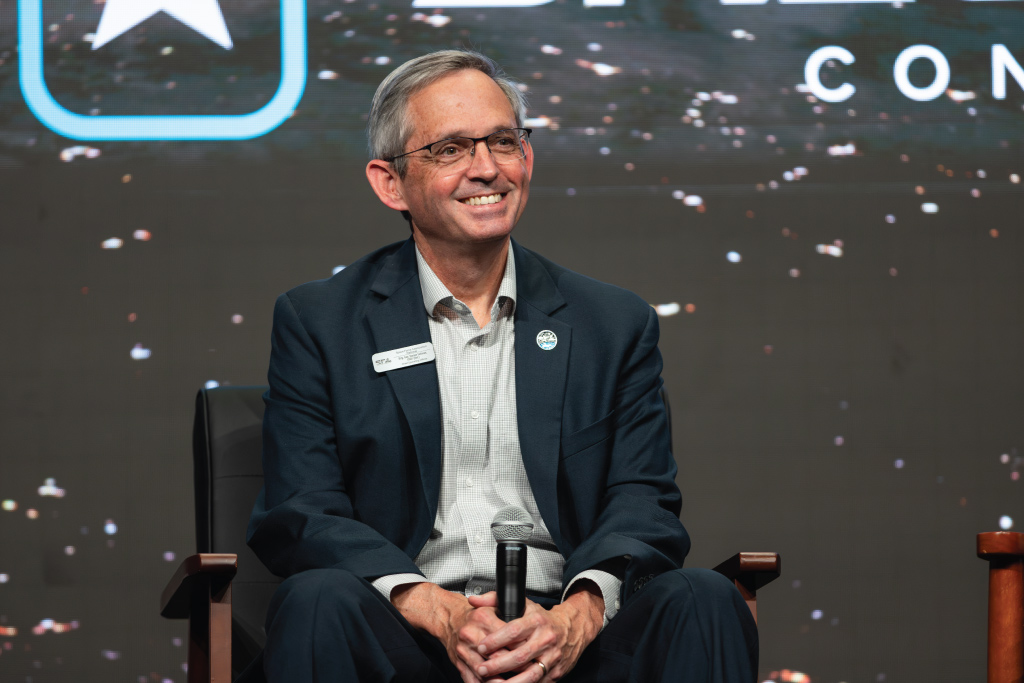
Feltman was announced CEO of Space Force Association at the third annual Spacepower Conference in December 2025, in Orlando, Florida. (Photo courtesy SFA / Remi Salva for Concrete Lion Pictures)
Continuing the Mission
Damon has spent the latter part of his career helping build the U.S. Space Force, which was launched in 2019.
“Only about 10 percent of the U.S. population knows the Space Force exists and understands what it does,” he said.
The Space Force Association was formed shortly before the new service to advocate for the Space Force and its members. Today, it is the only national military organization dedicated exclusively to supporting the Space Force and its Guardians.
After retiring from active duty — including 18 months with the Space Force — Damon volunteered with the association.
“It’s not uncommon for generals to find a way to give back to their service after they retire,” he said. “This is my way of giving back.”
He later joined the association’s national staff and became CEO in February 2026.
“Our goal is to be the premier external voice for the Space Force,” Damon said.
For the boy who once pretended to steer a spacecraft from his living room floor, helping others understand America’s newest military service is a fitting next mission.
The Space Force
Established in 2019, the U.S. Space Force organizes, trains, and equips military personnel to protect U.S. and allied interests in space. Its members, called Guardians, oversee satellites, missile warning systems, GPS, communications, and space surveillance — capabilities that are essential to national security and modern life.
“We aren’t building satellites or running a satellite manufacturing company. We’re building an organization that feeds the space ecosystem, and that’s pretty exciting,” Damon said.